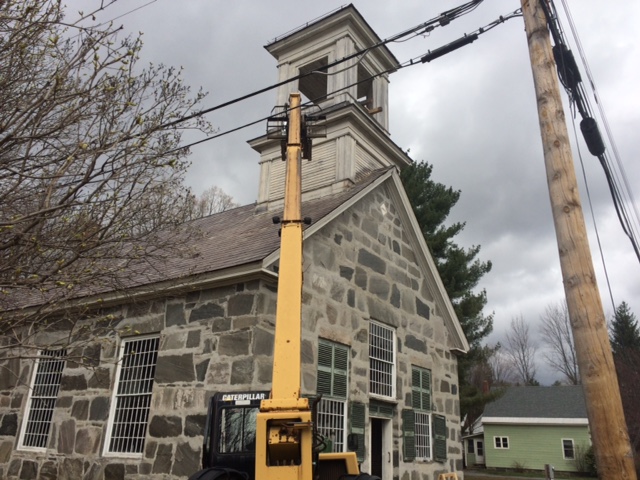
Act 46 Informational Meeting-April 25, 2017

In order to understand the special school vote on May 2 regarding Act 46, an informational meeting was held on Tuesday, April 25. Please note that LPCTV filmed this meeting and it can be viewed on Comcast TV or at the LPCTV website.

This is a complex issue and much has been written about it. At the end of this post are links for additional resources where you can learn more. You can also e-mail Fred Marin, who is Cavendish Town Elementary School (CTES) Board member and served on the Act 46 committee. 

Prior to the start of the meeting, the Cavendish School Board passed three resolutions, in preparation for the Act 46 merger, as follows:

• Transfer the majority of the deeded former Koti Lot to the Town of Cavendish for the Town’s continued use of the land for Water System and other purposes-a 300,000 gallon Town of Cavendish municipal water storage is located on this property. CTES will still be able to use the land for supervised recreational and science trails and nature walks. 

• To lease the land underlying the Community Library building to the Cavendish Board of Library Trustees for a period of 99 years with renewal option and provision for continuous right of way for access to the library over School District Property for the sum of one dollar per year.

ª To change the name of the Building for Books account to Town of Cavendish Building for Books Fund. This fund will now use the Town’s tax number. The special fund will continue to support library activities as well as educational opportunities for students.

All of these resolutions are permanent regardless of the town vote on May 2. 


State’s Mandate: Vermont’s student population has declined 20% in the last 15 years, resulting in the per student cost increasing education property tax rates. Voters are not only concerned about costs but also the educational opportunities for smaller schools. To address these concerns, Act 46 was passed and became law in 2015.

The essence of the law is that by having larger school districts, operational efficiencies can be maximized (increased flexibility to manage, share and transfer resources, with the goal of increasing the district-level ratio of students to full time equivalent staff), costs can be reduced or at least held in place, promote transparency and accountability, and there will be equality in the quality and variety of educational opportunity for all students.

The law comes with both carrots and sticks. If the towns merge as mandated, they can continue to benefit from small school grants and receive a tax break the first four years of operations-8%, 6%, 4% and 2%. In addition, by setting up a unified district that is agreed to, the state cannot add or subtract towns to that district.

If towns vote not to merge, on July 1, 2018 the state will assign them to a district without any of the benefits.

Bottom line- The state has mandated the formation of unified school districts and this will happen one way or another.


Background: In the 1960s, Cavendish merged with Chester/Andover to create the Green Mountain Union High School (GMUHS) for students in grades 7-12. The school was built in 1970. Prior to that students were going to Chester or Ludlow for high school, but the town had no say in how their students were being educated.

In 2013, as a result of Act 153, the Windsor South West Supervisory Union, which included Cavendish, Chester/Andover and Flood Brook, merged with the Rutland/Windsor District (Ludlow/Mt. Holly/Plymouth) to form Twin Rivers Supervisory Union (TRSU). Note that Flood Brook opted not to merge instead joining Rutland/Bennington. With the passage of Act 46, the TRSU members, plus the town of Baltimore, started meeting 18 months ago to see how to meet the newest state mandate.

By the fall of 2016, it became clear that the issue of Black River High School (BRHS) was a sticking point. With only 151 students, 25 per grade, and a declining enrollment plus a facility in major need of repairs, various options explored called for the closure of the school. In fact, keeping the school open would have dramatically increased taxes for the other participating towns. Note that Cavendish, Andover, Chester and Baltimore’s per pupil cost are well below that of Ludlow, Mt. Holly and Plymouth.

Mt Holly wanted to be part of the Mill River School District, as it’s much closer for them then GMUHS. However, in order for Mt. Holly to enter into such an agreement, their partnership with Ludlow needs to be dissolved.

Plymouth decided to seek unification with districts in the Windsor Central Supervisory Union, while Ludlow and Mt. Holly are asking their respective town voters to dissolve the educational agreement between the two towns, close BRHS and join Mill River Supervisory Union.

Consequently, the towns of Cavendish, Andover, Baltimore and Chester have moved forward and formed a regional education district (RED) to be called Green Mountain Unified Supervisory District (GMUSD). This is essentially the same structure as the old Windsor Southwest Supervisory Union minus Flood Brook and with the addition of Baltimore.

The State Board of Education approved the proposed GMUSD plan on March 21, 2017 and it is now up to the towns to vote on the formation of the unified district.


What Happens Under the Merger? The six schools (pre K schools in Andover and Chester; Chester-Andover grade school; GMUHS; and CTES) will be supervised by one board and will have one budget. The board would be comprised of six members from Chester, three from Cavendish and one each from Andover and Baltimore. The schools will now be “owned” by the District, with the responsibility of maintaining the schools born by the taxpayers of all the participating towns. In the event a school should be closed, the school, its contents and property revert back to the town.


Does the Town Lose Its School? School assets are not being turned over to the state.  When the RED forms, the new Unified District board (on which Cavendish will have 3 of the 11 positions) becomes the legal entity with responsibility for the assets.  The current Cavendish Board of Directors ceases to exist. The school, itself, cannot be closed without the consent of the voters of the Town of Cavendish, for a period of at least 4 years after formation of the RED (July, 2022). 


Is School Choice Still an Option for Grades 9-12? The state law provides 9-12th grade students an opportunity to go out of district for high school. The law remains unchanged and students still have to apply and be accepted to the high school if they wish to exercise this option.


What About choice for K-8? Currently TRSU allows students to go to other schools within the Supervisory Union. Under the new law, students that are attending another district school e.g. Cavendish students attending BRHS can continue to do so. It will be up to the new GMUSD board to determine in district and/or out of district choice for grades K-8.


If a Town Votes “No:” If Baltimore votes “no,” because it is an advisable town, the other towns can move forward with the GMUSD. If Andover, Cavendish or Chester votes “no,” then the merger is off. Towns who vote “no” can revote based on a petition of 5% of the voters of that town.

If the “no” vote remains, the state will then determine how the redistricting will take place minus any benefits.


Concerns Raised at the Meeting

• Dislike State Interference: More than one person voiced that they did not like the state mandating how we run our schools and forcing us into a district.


• Busing/Forcing Students to Go to Different School: Because one of the objectives of Act 46 is to increase the district level ratio of students to full time equivalent staff, what prohibits students from being bused from Cavendish to Chester to fill a grade? The board responded that Chester/Andover has exceeded max capacity by about 20 students and it was very unlikely this would happen. Further, the board was very concerned about busing and don’t want to see children traveling for long durations, particularly younger children. Joe Fromberger, the representative from Andover noted, in all his years of serving on the GMUHS board, the first and foremost concern was what was best for students.


• Why Wasn’t Black River High School Considered for CTES Students Since it’s Closer: A combination of factors including low enrollment, fewer educational opportunities and outdated facility resulted in the focus being on students going to GMUHS, which has a considerably newer facility, room for expansion, more than double the school population and more opportunities for students.


•  The state is continually making changes. In 2013 the TRSU was formed and yet the savings of $300,000 from the merger never seemed to materialize to the taxpayers benefit. It was explained that the reason the supervisory budget did not decrease was because certain costs were shifted from the individual schools (e.g. special education) to the district level.


• GMUSD Would Still be Small: There are only 700 students in the proposed GMUSD. With the area continuing to see a decline in young families moving here, what will happen if that number shrinks to 500 students? Could we be forced to close our school and send students elsewhere? While the GMUSD locks in the towns merged, it is still open to surrounding towns that may wish to join. Grafton, Rockingham and even Ludlow could consider joining.

Vermont has a significant issue with many people, particularly young families, leaving the state. Cavendish in particular has a problem because of its inferior telecommunications. Families and businesses are opting for other towns as a result. The Vermont “exodus” is a statewide problem and it’s going to take more than unified school districts to correct it.


•  GMUHS’s Capacity for Absorbing More Students GMUHS was built for 700 students and currently has 320. There is sufficient capacity to expand enrollment and it’s unlikely that there would be a mass influx anytime soon.


• Tax Rate: Tax rates for the unified district were presented to show that Cavendish would experience an initial drop from 1.5153 in FY 2017 to 1.4699 in FY 2019. This would then increase slightly each year so that by FY 2022, the per pupil cost for all schools in the district would be 1.6751


• Senate Bill 122-Act 46 Flexibility Legislation: Currently there is a bill moving through the VT legislature which would provide more ways for districts to combine, some with incentives such as tax breaks and grants; extends some deadlines; and tries to address concerns lawmakers heard at a public hearing this month. The bill would create three new regional education district merger options. It applies to areas where geographic isolation is a problem; where districts don’t align in the grades they operate or tuition; or where there are significantly differing levels of indebtedness between districts. The legislation also extends timelines if voters have turned down a merger proposal or if another district wants to join. The legislation provides schools with transition grants and frees up grant requirements so money can be used for community engagement. Learn more about the legislation as it currently stands as of April 20 at House Committee Puts Own Spin on Act 46 Flexibility

It’s unclear if Cavendish would qualify under the proposed bill. The legislative session is rapidly drawing to a close and there is considerable work that’s needed before the bill can pass.


Take Home Point: Ultimately the “take home point” of the school board and Act 46 committee was pretty straightforward.  The state is mandating unification and it’s going to happen regardless of how the voting turns out. If you vote for the GMUSD, things pretty much stay the same for Cavendish students and the town gets some carrots (continue to receive small school grants, have a tax break the first four years of the unified district, lock in partners in the merger and therefore not subjected to changes by the state). If the merger is voted down, the state will assign which district Cavendish will be part of and will not receive the tax benefit. 


Voting: The polls-CTES- in Cavendish will be open from 9-7 on May 2. Voters will decide whether they wish to be part of the GMUSD. They will also select three board members to serve on the unified board in the event the GMUSD is voted in. Those running for the unified district school board, all unopposed, are Fred Marin, Doug McBride, and Bruce Pollard


Resources

• Two Rivers Supervisory Union Act 46 Study Committee Report: Obtain a copy from the Cavendish Town Office.

TRSU Act 46 Study Committee


Job Opening

Tasting room Staff Brook Farm Vineyards and Circa 1810: Brook Farm Vineyard is looking for a friendly and experienced tasting room staff member to join our team. This is a full time position. Primary duties and responsibilities include, but are not limited to the following:

• Greet guests at the door in a warm and friendly manner. 

• Seats and presents menus to guests in a friendly, professional, and quick manner. 

• Pours flights of wine and educates customers about the wines they are drinking.

• Have an understanding of cash & credit transactions- Makes, confirms, cancels and edits reservations.

• Answers phone and answers questions concerning the menu and the tasting room. 

• Interacts with guests in and as they leave the restaurant to ensure positive tasting experience. 

• Take and fill orders. 

• Other duties as directed. 


The ideal candidate must posses the following:

*Must be able to work evenings, weekends and holidays, as needed.

* Must have a Certificate of First Class Seminar Attendance from Vermont Department of Liquor Control or be willing to get one.

• Excellent communication skills

• Team oriented

• Organizational skills 

• Able to multi-task 

• Punctual and reliable

• Ability to stand during entire shift 


For more information or to apply contact Jennifer McBride, Brook Farm Vineyards Jen@BrookFarmVineyards.com, or call 802-226-7152

Cavendish Update 4/21/17 News/Sewage/School Vote

IF YOU COUNT ON CAVENDISH CONNECTS TO KEEP YOU INFORMED, WE NEED TO BE ABLE TO COUNT ON YOU

 SUPPORT CAVENDISH CONNECTS


 4/21/17 Cavendish Update

1. Cavendish Related News

2. Annual School Meeting: Cavendish School District Warning

3. Sewage Discharged into the Black River

4. Events


1. CAVENDISH RELATED NEWS

Congratulations to Zach McNaughton: Once again Proctorsville’s resident Zach McNaughton has led a group of his students at River Valley Technical Center to win the Gold Medal in Television Production at SkillsUSA, Vermont. As such these students have qualified to represent Vermont at the SkillsUSA National Conference/Competition in Louisville, Kentucky. They are looking for sponsors to help make the trip possible. VT Journal

Three Car Collision at 103 and 131: State Police investigated a 3-car collision at the intersection of VT Route 103 and VT Route 131 in Cavendish, 2pm on April 14 (Friday). This crash occurred as vehicle #3 (Martin Nitka, Ludlow) was stopped southbound on VT 103 waiting to safely turn left onto VT Route 131. Vehicle #2 (Driver Roger Brown of East Burke, VT) was stopped directly behind vehicle #3. Vehicle #1 (Driver Rolland Hall of Keene, NH) was traveling south and did not notice the other vehicles stopped in front of him until the last second. Vehicle #1 had a rear end collision with vehicle #2. A chain reaction occurred as vehicle #2 rear-ended vehicle #1. No injuries were reported. This crash is still under investigation. VT State Police.

GM Board Sanctions LGBTQ Comments of Fellow Member: The GMUHS board sanctioned the comments of one of its own at its regular meeting on Thursday, April 13, as a room full of faculty, staff, students and other board members aired their outrage over comments made at the March 9 meeting by Andover representative Hank Mauti. Chester Telegraph

Burned Ascutney Gas Station to be Replaced: The owners of an Ascutney gas station that was heavily damaged following a burglary and fire are hoping to replace it with a new, larger facility as part of a roughly $1.5 million project. The oil company applied on March 10 for a zoning permit to replace the burned convenience store with a roughly 4,800-square-foot Jiffy Mart gas station and convenience store. The Circle K store was about 2,200 square feet in size. In addition to the canopy and the proposed convenience store, the site plan features a proposed counterclockwise drive-thru lane for a fast food restaurant, and a bypass lane extending around the back of the store. the drive-thru will be for a Subway restaurant, with seating for 20 inside.  Eagle Times 


2. ANNUAL SCHOOL MEETING: CAVENDISH SCHOOL DISTRICT WARNING: In response to Act 46, the legal voters of the Cavendish Town School District are warned about a special vote on May 2, at CTES between the hours of 9 am and 7 pm to decide if they wish Cavendish to be part of the Green Mountain Unified School District with Andover, Chester and Baltimore. Cavendish students would continue to go to CTES and GMUHS. The changes would be as follows:

• One 11 member school board would serve for all schools. The composition of the board would be as follows: Andover-1; Baltimore-1; Cavendish-3; Chester-6

• The unified union school would assume the indebtedness of member districts and assume all operating deficits and/or surpluses or reserve funds of the member districts; acquire and pay for the school properties of member districts.

• The provisions of the Final approved by the State Board of Education on March 21, 2017, is on file in the Cavendish Town Office, shall govern the unified union school district.

Article II of the Warning is the election of three school directors to serve on the board of the proposed unified union school district.

The legal notice is available at The Vermont Journal.

There will be an informational meeting about the vote on April, 25, 6:30 pm at CTES. 


3. SEWAGE RELEASED INTO BLACK RIVER: Many people were shocked to learn from television or Facebook that up to 1million gallons of partially treated sewage was released into the Black River by the Ludlow wastewater treatment facility. beginning 11 am Friday (April 14) and lasting until about noon Saturday (April 15). The sewage was not fully disinfected before it was released and resulted in a river E.coli level of 770 bacteria colonies per 100 milliliters (mLs). The acceptable level of E.coli colonies in Vermont is 235 per 100 mLs. My NBC

To address the concerns being raised about the safety of the river, why it happened, why wasn’t the town notified and what can be done to keep the community informed, Cavendish Connects has developed an in-depth article at The Dish.


4. EVENTS

APRIL 22 (Saturday): Earth Day

APRIL 25 (Tuesday): Informational Meeting on May 2 Unified School District Meeting

APRIL 29 (Saturday): Got Drugs? Turn in unused or expired medication for safe disposal.

APRIL 30 (Sunday): Raise the Roof Concert-Maple Jam, 4 pm Gethsemane Church, Proctorsville, Cost $10.


For information on upcoming events, go to the Cavendish Connects Calendar

Sewage Discharge Into the Black River

Many people were shocked to learn from television or Facebook that up to 1million gallons of partially treated sewage was released into the Black River by the Ludlow wastewater treatment facility (WWTF). beginning 11 am Friday (April 14) and lasting until about noon Saturday (April 15). The sewage was not fully disinfected before it was released and resulted in a river E.coli level of 770 bacteria colonies per 100 milliliters (mLs). The acceptable level of E.coli colonies in Vermont is 235 per 100 mLs. My NBC

Concern is being raised about the safety of the river, why it happened, why wasn’t the town notified and what can be done to keep the community informed.

In preparing this article, Cavendish Connects has spoken to the Cavendish Town office, the Black River Action Team (BRAT) and the Agency of Natural Resources (ANR), Department of Environmental Conservation (DEC).

Reporting of Wastewater Discharge: The Agency of Natural Resources (ANR)  requires that Wastewater Treatment Facilities (WWTF) provide a public alert as soon s possible, but no longer than one hour from discovery of an untreated discharge from the wastewater treatment facility. This time requirement is extended to no longer than four hours if the operator does not have telephone or Internet service at the location or they are working to control or stop the untreated discharge. Additional details regarding sewage overflows and incidents are required to be reported within 12 hours of discovery and are included at the DEC (Dept. of Environmental Conservation) website.

Operators are required to post temporary signs at public access areas for 1 mile downstream of sewage discharges and other unpermitted discharges identified by the Secretary that may pose a threat to human health or the environment.  The signs must remain in place for 48 hours after the untreated or unpermitted discharge has stopped. More information about this process is available here.

Since the discharge started the day before, for a 24 hour period partially treated undisinfected effluent was discharged into the Black River somewhere between 500,000 to 1 million gallons, without notification.

Why this Discharge Occurred: The report states, Preliminary lab report of 770 colonies/ 100 mls e-coli believed to be caused by ineffective chlorination. This was most likely caused by nitrification in the secondary clarifiers, while we had the aeration/mixers shut off to hold suspended solids. High flow conditions threatened plant wash-out of solids.

According to Amy Polaczk of DEC, Wastewater treatment is a biological process. In the case of the Ludlow Plant, an oxidation ditch is used to break down organics followed by a secondary clarifier to settle suspended matter, prior to discharge the effluent is chlorinated to inactivate any pathogens that may be present and then dechlorinated as chlorine is toxic to aquatic life in the receiving stream. Because of the high flows through the plant due to rains and snow melt, the operators of the Ludlow WWTF were trying to avoid sending solids to the Black River and to do that they turned off the aeration and mixing. A major component of wastewater treatment is the conversion of ammonia to nitrogen gas. This conversion is a two-step process, first nitrification is the process where ammonia is converted to nitrate/nitrite and then denitrification where the nitrate/nitrite is converted to nitrogen gas. If this process begins but is not complete, nitrate and nitrite will react with chlorine and reduce the amount available to inactivate pathogens. This combination of events is what is believed to have caused high E.coli counts in the Ludlow effluent.

 What About the E-coli Levels?: There are various types ofE.coli and not all of them make your sick.  Nearly every mammal and bird carries it and there are many ways it can get into the river- bird droppings, agricultural run-off, diapers, feces from people or pets, storm water runoff, or even naturally occurring E. coli present in the soil. Just because there are 770 per mL of E. coli does not mean that there are 770 E.coli cells that can make you sick. If there were, the only way it can do so is through oral ingestion. For healthy humans, the infectious dose of E. coli (only the ones able to cause disease) needs to be in the range of 100-10,000 cells. Typically in order to acquire enough of the pathogenic bacteria you would have to swallow water.

The VT Health Department recommends that those using rivers, streams and ponds

• Heed posted advisories or closings

• Do not swallow the water or get it in your mouth

• Stay out of the water 48 hours after a significant rain event

• Shower after swimming; and wash hands before eating.

Learn more at Healthy Recreational Waters

 Corrections: The correction action taken is listed as “aeration was resumed and chlorination system was inspected. Effective levels of disinfection are expected to return within 24 hrs., pending return of manageable flows.”

Notifying Cavendish: To make sure that the community is informed in a timely manner of any discharge,  multiple people in Cavendish will now be receiving the DEC Alerts. You can do this as well by signing up at their website. You can receive these by e-mail or text. 

If a discharge should occur again, it will be posted immediately to Cavendish Connects blog, Facebook and to Update subscribers. BRAT is planning a new feature at their website entitled “Alerts,” which will also be shared at their Facebook page.

Testing of the Black River: For those who swim and regular recreate in the Black River, BRAT will once again be testing the Black River in Cavendish. Thanks to underwriting by Okemo, Cavendish will have water tested at Greven Field and the Cavendish Gorge. In addition to these locations, they will also be testing weekly at Buttermilk Falls (Ludlow), North Branch at Little Ascutney Rd (near Downer’s Four Corners), Downer’s Covered Bridge on Upper Falls Rd in Perkinsville and Tolles Power Dam off Maple St in Weathersfield/Perkinsville. This information is posted on-line at the BRAT site and in the event of an unsafe reading, Cavendish Connects will post this information to their outlets. Thank you Kelly and BRAT for your continued dedication to our River and your help in keeping it a safe recreational area.

How to Protect the Black River: BRAT has a number of programs that support the Black River. Check their website for ways to be involved. BRAT will be at the Cavendish Town Wide Tag Sale July 29th on the Proctorsville Green. This is a good time to ask questions, raise concerns and learn how to become involved in protecting the health and safety of the River. There is a also a possibility that Kelly will be doing a regular show on LPC-TV about the Black River.

Stocking: For those interested in the trout stocking on the Black River, it will take place the weeks of May 1, 8, 15 and 22. A total of 2,000 two-year old trout (1,500 rainbow and 500 brown) will be released.